


Article
Agricultural Detachable Chain & Attachment Links
What it is: interlocking formed-steel chain used on certain agricultural machines and conveyors.
Detachable chain uses interlocking formed steel links. Unlike conventional roller chains, the links are designed to be disassembled at specific points, making them useful on some older and specialty farm machines. Common applications include agricultural conveyors, manure spreaders, elevators, and other equipment designed specifically for detachable chain.
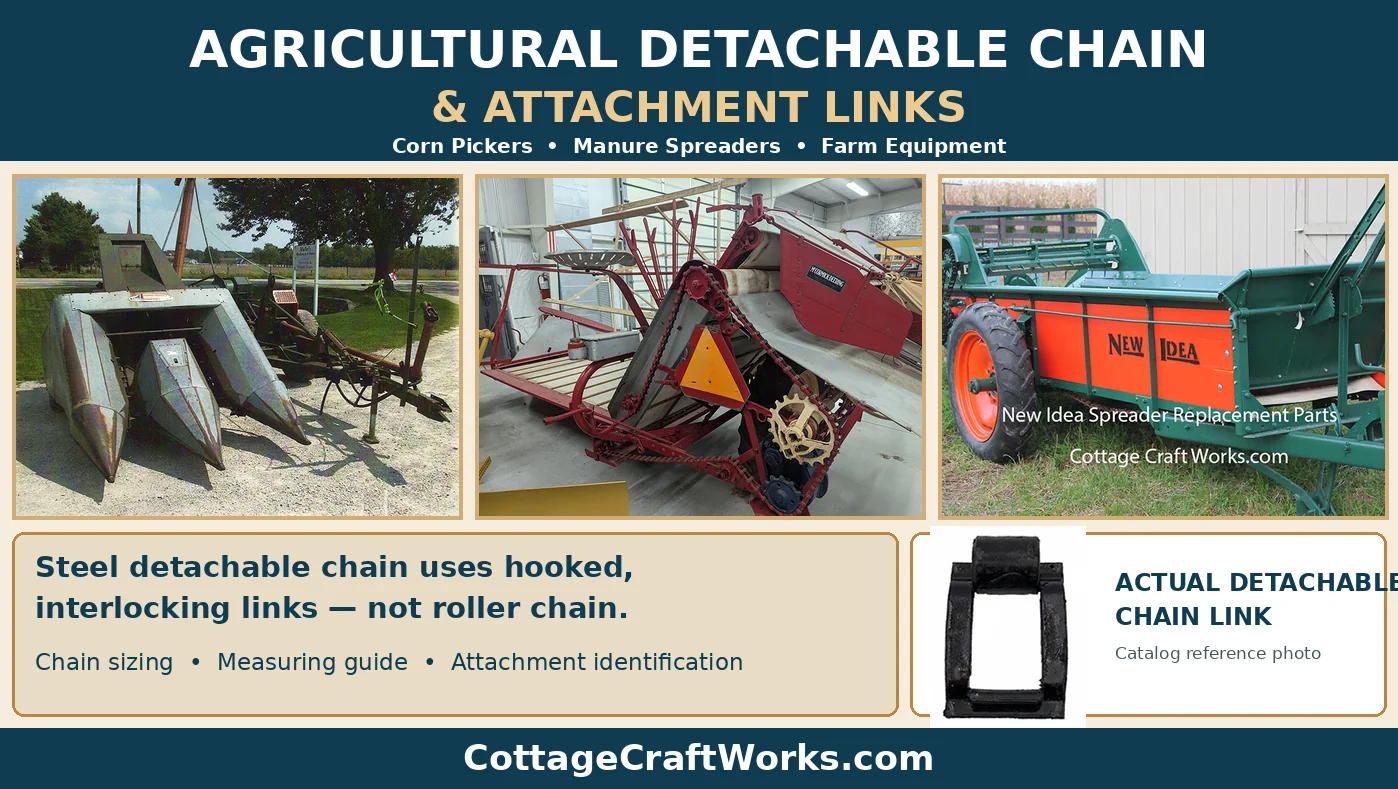
Steel detachable chain is used in agricultural equipment and conveying applications where links may need to be assembled, removed, or replaced without dismantling an entire drive. This guide explains the key dimensions to consider when identifying a replacement chain or matching an attachment link.
Before ordering: Match the original chain number when available, then verify the actual dimensions and attachment configuration. Chain numbers alone are not a reliable substitute for measurements. Check the machine manual for the required chain type, strength, and operating conditions.
1. What is an agricultural steel detachable chain?
A detachable chain uses interlocking formed steel links. Unlike conventional roller chains, the links can be disassembled at specific points, making them useful on some older and specialty farm machines. Common applications include agricultural conveyors, manure spreaders, elevators, and other equipment designed specifically for detachable chain. Always verify the equipment's original specifications rather than assuming all detachable chains are interchangeable.
2. How to measure detachable chain
How to identify chain size and determine replacement length
Use the illustrated guide below to understand the chain path around the sprockets and estimate the length needed. For the correct chain size, confirm pitch by measuring between the centers of adjacent chain joints and comparing the other dimensions in our chart. Sprocket tooth-tip spacing alone is not a reliable final pitch measurement.

Clean the chain and, if possible, measure an unworn sample. A digital caliper is strongly recommended for decimal measurements. Compare more than one link: wear, stretching, and deformation can change readings.
- Find the pitch (P). Measure between equivalent joint centers on adjacent links, following the reference drawing. Do not measure overall link length and call it pitch.
- Measure overall width (M). Measure the widest outside dimension indicated in the drawing.
- Measure inside opening (E). Check the clear opening where the connecting link or attachment must fit.
- Measure hook dimension (D). Use the exact points shown in the reference diagram.
- Measure steel thickness (T). Use calipers and compare with the tolerance shown for the chain size.
- Compare the full set of dimensions. Two chains may look alike but have different widths, thicknesses, or strength ratings.
Measurement-point drawing
Decimal and ruler reference
0.500 in = 1/2 in; 0.750 in = 3/4 in; 1.000 in = 1 in; 1.508 in ≈ 1 1/2 in; 1.654 in ≈ 1 21/32 in; 2.313 in ≈ 2 5/16 in. The fractions are approximate—use decimal caliper readings for identification.
3. Detachable chain size and dimension chart
The following data are transcribed from our reference sizing chart. All dimensions are in inches unless noted. The listed chain sizes are reference sizes, not a statement of current stock availability. Confirm measurements and specifications with the manufacturer before publication or ordering.
| Chain | Links / 10 ft | Lb / 100 ft | Ultimate strength (lb) | Minimum strength (lb) | P pitch | M width | E opening | D hook | T thickness |
|---|---|---|---|---|---|---|---|---|---|
| 25 | 133 | 20 | 950 | 760 | .904 | 45/64 | .438 | .422 | .073 ± .006 |
| 32 | 104 | 32 | 1650 | 1320 | 1.157 | 1 5/16 | .610 | .594 | .090 ± .006 |
| 32W | 104 | 39 | 1650 | 1320 | 1.157 | 1 7/16 | .610 | .594 | .079 ± .006 |
| 33 | 86 | 39 | 1650 | 1320 | 1.402 | 1 1/16 | .627 | .610 | .095 ± .006 |
| 42 | 87 | 50 | 2300 | 1680 | 1.375 | 1 7/32 | .800 | .781 | .105 ± .006 |
| 50H | 87 | 63 | 2600 | 2240 | 1.375 | 1 9/32 | .798 | .781 | .125 ± .006 |
| 51 | 106 | 40 | 2100 | 1680 | 1.133 | 1 3/32 | .720 | .703 | .105 ± .006 |
| 52 | 80 | 66 | 2700 | 2160 | 1.508 | 1 13/32 | .760 | .840 | .125 ± .006 |
| 55 | 74 | 62 | 2800 | 2240 | 1.630 | 1 9/32 | .813 | .796 | .125 ± .006 |
| 62 | 73 | 90 | 4200 | 3520 | 1.654 | 1 9/16 | 1.002 | .984 | .148 ± .007 |
| 62A | 72 | 131 | 5500 | 4000 | 1.654 | 1 15/16 | 1.002 | .984 | .172 ± .007 |
| 62H | 73 | 112 | 4400 | 3600 | 1.654 | 1 7/8 | 1.002 | .984 | .148 ± .007 |
| 67H | 52 | 137 | 5500 | 4400 | 2.313 | 1 7/8 | 1.110 | 1.093 | .185 ± .007 |
| 67XH | 52 | 145 | 6800 | 5500 | 2.313 | 1 7/8 | 1.110 | 1.093 | .200 ± .010 |
| 67W | 52 | 144 | 4800 | 3800 | 2.313 | 2 3/8 | 1.110 | 1.093 | .148 ± .007 |
| 70 | 60 | 130 | 4800 | 4000 | 2.013 | 1 15/16 | 1.110 | 1.093 | .172 ± .007 |
| 72 | 59 | 131 | 4800 | 4000 | 2.025 | 1 15/16 | 1.110 | 1.093 | .172 ± .007 |
| S | 41 | 130 | 4800 | 3840 | 2.906 | 1 15/16 | 1.116 | 1.093 | .172 ± .007 |
| 72 1/2 | 73 | 115 | 4500 | 3600 | 1.643 | 2 | 1.172 | 1.156 | .148 ± .007 |
Strength values are reference ratings, not permissible working loads. Do not use ultimate or minimum breaking strength as a working-load rating. Confirm all tolerances and the machine manufacturer's requirements.
How much does a 10-foot section weigh?
Divide the published pounds-per-100-feet figure by ten. For example, No. 25 weighs approximately 2.0 lb per 10 ft; No. 67XH approximately 14.5 lb per 10 ft. Other listed sizes may weigh slightly more or less than No. 67XH, so compare the full chart rather than assuming a particular number is always the heaviest. Packaging adds to shipping weight.
4. Understanding detachable chain attachment links
Attachment links are specialty links that connect chain to a flight, scraper, slat, crossbar, carrier, or other equipment component. They are not all interchangeable, even if the base chain size matches. Attachments may differ in mounting position, direction, hole size, offset, and orientation.
What to compare on an attachment link
- Chain designation: match the parent chain size and geometry.
- Attachment type and direction: identify whether the mounting feature faces inward, outward, upward, or downward when installed.
- Hole spacing and hole diameter: measure center-to-center distances and hardware clearance.
- Offset and overall dimensions: confirm that flights or slats will clear the equipment frame.
- Left-hand versus right-hand: verify mirrored configurations where applicable.
- Quantity: determine whether the machine uses single, paired, or regularly spaced attachments.
Use our four attachment-link identification picture pages to match the shape and part number, then compare the dimensional drawing below each link. Do not order by appearance alone. The picture-page numbers are identification aids, not chain size numbers.
5. Choosing between a replacement link and a 10-foot section
You may replace a single damaged link when the remaining chain is within the manufacturer's wear limits. If multiple links are worn, stretched, bent, cracked, or corroded, replacing a complete section may be more appropriate. Verify sprocket condition, chain tension, and alignment; worn sprockets can quickly damage new chain.
6. How to order the correct chain or attachment
- Find the equipment make, model, and original part number, if available.
- Identify the chain size using the measurement chart.
- For a 10-foot section, select the matching chain designation and required length.
- For an attachment link, match its photograph, part number, mounting geometry, and measurements.
- Confirm the quantity and any left/right orientation.
- Review current product-page price, availability, lead time, and shipping before checkout.
7. Installation and safety considerations
Turn off and lock out equipment before inspecting or changing chain. Never work near a moving conveyor or exposed sprocket. Follow the manufacturer's instructions for link orientation, chain tension, guards, and lubrication. Do not weld, bend, or modify a link to make an incompatible part fit. Do not substitute chain with a lower required rating.